The Same Crypto Symbol Can Describe Different Trades
Map venue, pair, settlement asset and product type before comparing a crypto call with an account outcome.
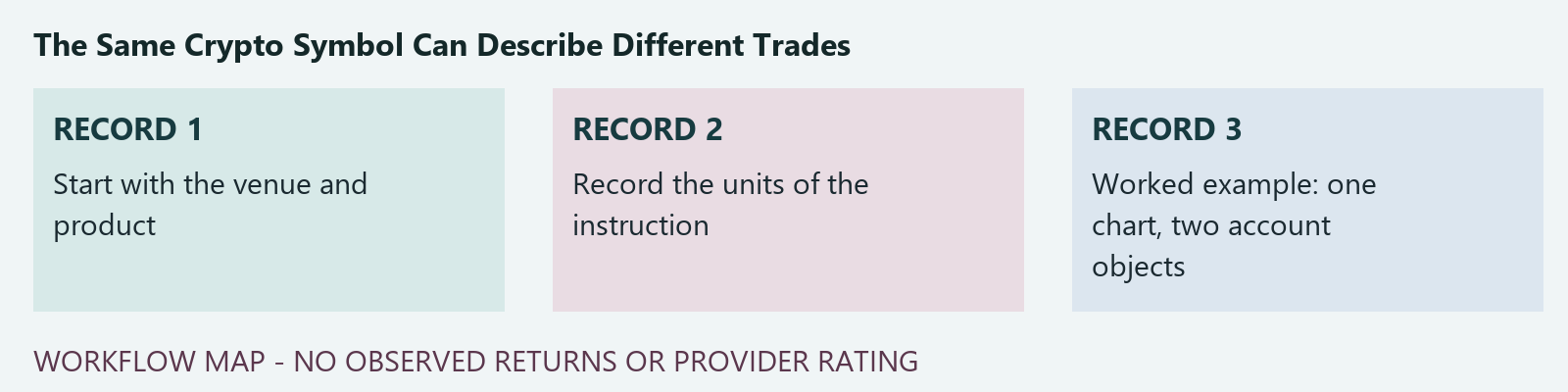
Start with the venue and product
Write exchange or broker, jurisdictional offer, exact market identifier and whether the instrument is spot, a perpetual or a dated derivative. A symbol such as BTC against a dollar-like quote does not fully identify the trade. Settlement, collateral and product rules can differ across venues. A review should distinguish the signal author's declared market from the one the subscriber can actually access. Do not treat general crypto commentary as proof that a particular product or region is supported.
Record the units of the instruction
Identify base quantity, quote currency, contract multiplier and the currency in which account profit is measured. Retain the price source and time convention. A displayed move in the underlying can differ from a derivative account outcome after funding, fees and conversion. TradingView alert documentation is a reference for alert transport, not a guarantee that a crypto market mapping is correct. Ask for the mapping table and source specification instead of trusting a familiar-looking symbol or integration label.
Worked example: one chart, two account objects
Invent an underlying price moving from 100 to 105. A fictional spot holding of two units has a 10-unit price gain before costs. A hypothetical derivative referencing the same asset might have a different quantity convention, collateral currency and funding flow; its result cannot be recovered from the chart alone. Leave those fields unknown rather than inventing a leverage multiple. The point is not to select the more profitable product. It is to identify the economic object before calling two subscribers' outcomes comparable.
Keep funding and liquidations out of the headline shortcut
Request the actual funding schedule, charge observations, margin rules and liquidation events applicable to the purchased venue product. Do not substitute a generic online calculator for the account ledger. Margin terminology from exchange education can help frame questions but does not provide a crypto venue's current policy. A claimed stop price is not necessarily where an account exits. Separate planned loss, observed close, forced action and unresolved exposure so a provider review does not erase product-specific risks.
Inspect changes and unavailable markets
A call may arrive after a market is delisted, inaccessible, paused or renamed. Keep skipped and rejected instructions in the denominator used for delivery and usability assessment; they are not automatically losing trades, but they are not successful subscriber executions either. Record versioned amendments when the provider changes venue or pair. A timestamp can address committed content, yet it cannot establish that the subscriber's substituted instrument had equivalent exposure or that the channel included every original call.
Decide whether the service fits your account
Prepare a market mapping before purchase, then confirm required software, permissions, archive access and cancellation terms. Documentation-based comparison can establish stated features while leaving performance untested. CFTC customer material provides risk and fraud context, not an endorsement of a crypto provider. No source-linked profile in this workflow is a paid-account execution study. A sensible outcome is declining a service whose calls cannot be matched to the products you understand and are actually eligible to use.
Decision record
| Question | Record to retain | Decision boundary |
|---|---|---|
| Market identity | Venue, product ID and region | A familiar symbol is not a complete trade object |
| Settlement | Collateral, multiplier and profit currency | Underlying percentage move is not account return |
| Account events | Fees, funding and forced actions | A planned stop cannot reconstruct liquidation |
| Access | Rejected or unavailable instructions and amendments | A substituted market requires a new exposure check |
Blank working record
The worksheet contains column headings only. Enter your own dated observations, keep absent evidence marked unknown, and do not treat the file as certification.
 Download worksheet (CSV)
Primary references
- TradingView: webhook delivery and configuration
- CME: performance bonds and margin
- CFTC: AI trading claims
These documents support mechanisms and source definitions, not a tested trading result or a recommendation. Accessed 9 October 2026. The decision workflow and invented examples above are editorial exercises.
Keep reading
Publication methodology | Working glossary | Source and correction policy
Complete a second mapping with mismatched quote units
In an invented source record, the instruction names SAMPLE/Q-ONE on V-ONE, while the receiving account exposes SAMPLE/Q-TWO on V-TWO. The names resemble each other, but quote unit, venue and executable price source differ. A conversion between Q-ONE and Q-TWO is not supplied. The finished packet reports two product identities and no reproducible same-unit outcome, rather than treating an attractive chart as the missing conversion.
If a platform uses contract counts, obtain the multiplier and product definition before interpreting a quantity field. A request labelled ten can mean ten tokens or ten contracts with a very different exposure. Do not import a familiar spot size into an unspecified derivative. A useful completed mapping can show exactly why an outcome calculation cannot yet be completed.
Keep product versions and observation boundaries
A fictional venue changes its allowed quantity increment after the original source note. Preserve the dated definition used for each operation and identify whether the reader could access that edition at the declared time. A current specification alone does not reconstruct a historical order. Original acknowledgements and fills still need their own records after a product map is complete.
The mapping conclusion distinguishes compatible identity, unresolved conversion, incomplete quantity and missing account operation. It is not an endorsement of either invented venue or a recommendation to change products. This extension preserves the original venue worksheet while demonstrating another finished mismatch case, rather than repeating the spot-versus-contract chapter.
Related research
Retained source references
- TradingView: webhook delivery and configuration
- CME: performance bonds and margin
- CFTC: AI trading claims
References retain the original source trail; a link is not evidence that every private claim or account record was independently audited.